
For Family and Supporters of Global Cougs
Family and supporters play an indispensable role for students, not only in choosing a program, but also in deciding whether to study abroad at all. This information is designed to assist you in helping your coug become a global coug at Washington State University.
Why should your coug study abroad
Studying abroad affects students’ personal growth while influencing their academic commitment and professional aspirations.
- 87% of returning students said study abroad influenced subsequent educational experiences (Career Outcomes of Study Abroad Students, IES Abroad, 2015)
- 80% reported an enhanced interest in academic study (same 2015 study listed above)
- On average, students who study abroad earn $4,159 more in their first job after graduation (International Experience as a Career Asset: Exploring the Earning Impact of Education Abroad Participation, The Forum on Education Abroad, page 7, 2025 (PDF) )
How to support your coug
Help them define their goals and hierarchy of values
Why does your student want to study abroad? The answer to this question is different for each student. Perhaps they want to take the chance to see more of the world. Perhaps they want to broaden their academic experiences. Students’ goals for study abroad can be academic, professional, personal, or a mixture of all.
What does your student want most out of their experience? What aspects of study abroad make them most excited or nervous? If they’ve never been abroad before, having extra support from a provider may be higher on their list. If they’re feeling independent and really want to feel what it’s like to be a student living in their host country, perhaps they’re up for the challenge of a more self-sustaining program like an exchange.
There is an abundance of programs out there for your students. Knowing what they want their experience to be will help them narrow it down. Areas to consider are course availability, housing options, level of support, excursions, and other included benefits, and cost.
Funding and budgets
Budgeting early can help students make their study abroad experience more affordable. Including what they want to do while abroad, in addition to all the necessities, can help them plan for fun and figure out what experiences are worth the investment to them.
Help them look into and consider different avenues of funding:
- Understanding how their financial aid may apply
- Look into scholarships for their major or location
- Check for funding from their College
- Save earnings from part-time or seasonal work
- Fundraise within their home community
Steps for staying involved
Talk with your student
Know what they’re looking for and how the application process is going. Offer support in the areas above.
Visit websites
Take a look at the rest of our website for more resources. Search for programs in our program discovery or check out a shorter list of curated programs for your student’s major.
Ask questions
Feel free to contact our office with any questions or concerns you may have. We are more than happy to help. However, unless your student has completed our Family Educational Rights and Privacy Act (FERPA) form in their mystudyabroad application, Education Abroad staff won’t be able to provide specific information about your student. Until then, we can talk generally about our study abroad processes and programs.
Frequently asked questions
What if my student has a problem while abroad?
Most study abroad programs provide on-site support in each of the locations where we have programs. These offices are staffed with professionals who conduct orientation and support students throughout their time abroad. Their primary job is to prepare students for the academic and cultural differences in their host country. We strongly encourage our students to contact their program provider or on-site international student office in their host country if they experience problems, either personally or related to their studies. The staff in these offices are familiar with the academic and social challenges of study abroad in that country. They are trained to help students solve problems. In addition to maintaining each on-site office, on-site staff abroad keep cell phones for student emergencies. In the event of an emergency outside of office hours, a student can call the emergency number to receive assistance from on-site staff.
How do I contact my student while they’re abroad?
Most parents use a combination of email and telephone to maintain contact with their students. Most programs and affiliated universities assign email addresses to students; however, we also encourage students to stay connected to their WSU email while abroad. International phone plans are encouraged as well, but are up to individual students to set up. WhatsApp is an easy and affordable way to stay connected too!
Will my student be safe abroad?
Understandably, safety is one of the concerns we discuss most often with parents. Our office receives updates from the U.S. Department of State about changes in travel advisories and will cancel programs if there is a serious concern for safety. Our comprehensive, mandatory orientations address health and safety issues relevant to student safety, and on-site staff and program resident staff are careful to keep students aware of locations and situations that can present danger. In addition, the information we provide to students contains extensive information about staying healthy and safe.
While some parents and students focus their concerns about study abroad on the cataclysmic—acts of terrorism, violent crime, or natural disasters—the truth is that, just as in the United States, much of a student’s safety abroad depends on his or her exercising mature and responsible behavior, and on making good decisions. Traveling with companions rather than alone, especially late at night; using caution in interactions with strangers; staying away from dangerous areas or activities; not drinking to excess, and avoiding the use of illegal drugs; following the laws and knowing and respecting the customs of the country—these are the best ways your student can maximize their safety abroad, just as at home.
Will there be other students in the program?
There may or may not be other WSU students studying abroad with your student. However, there will typically be students from other U.S. universities or countries. Many programs offer group flights for most programs, so students need not travel alone, and our orientations are a great way to share excitement with other students.
What kinds of housing and meal arrangements are available?
Depending on the type of program your student has applied to, the housing and meal arrangements will vary. Housing options can include residence halls, apartments, homestays, and hotel accommodations. Similar to attending WSU, students who study abroad at international institutions may have access to an on-site dining facility. For students living in homestays, usually breakfast and dinner are included in program fees. Similar to attending WSU, regardless of meal plans, we recommend that students budget for additional meals while traveling independently or for when dining off campus
What are my options for paying the program fees? Are they expensive?
For WSU Education Abroad faculty-led programs, students will be billed tuition and fees through their myWSU account. For bilateral exchange programs, students will be billed tuition through their myWSU account, but will pay for their housing. For International Student Exchange Program (ISEP), students will pay all university fees (tuition, mandatory fees, housing, and meal plan) through their myWSU account. For other study abroad program options, students will pay the provider organization directly for tuition and fees. They may also have payment plans and can allow students to use their financial aid.
Does financial aid apply?
In some cases, students may be able to use at least some of the same financial aid packages they receive at WSU for study abroad on affiliated programs. For a detailed list of how financial aid may apply, please see the Student Financial Services webpage. Guaranteed Education Tuition (GET) funds may be applied as well.
Hear from your students’ peers about their own study abroad experience

“Studying abroad has helped me grow in ways I never expected. It has strengthened my independence, expanded my professional network, and encouraged me to embrace every new experience. From Dubai to Florence, each program has shaped my confidence and my curiosity about the world.”
Kennedy Brents
“Studying abroad as an exchange student in Spain, made me appreciate more about the world’s wonders. I always imagined myself as a world traveler and with studying abroad, it made it a possibility. Coming from a low-income background, finances were always a difficult conversation to navigate, but with the pursuit of where I wanted to go and who I wanted to be, I ventured out and risked it, which made it all worthwhile. Studying abroad taught me that as students we shouldn’t limit our possibilities to explore different regions of the world even with restrictions that impose fear in us to not do something that expands our worldview.”
Crystal Preciado
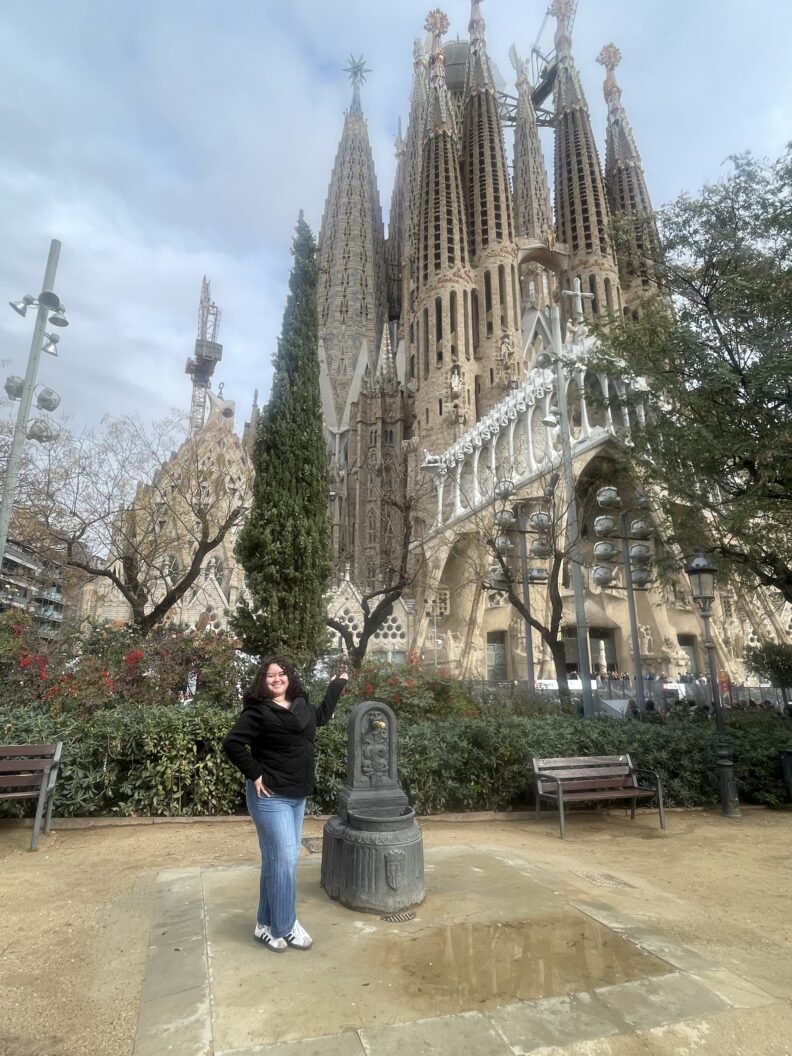

“Studying abroad was one of the best experiences of my life. When I arrived in Paris for my semester abroad, I did not know what to expect. I was nervous, but also super excited. Over my four months there, I was given the opportunity to explore a new culture, visit breathtaking places I never thought I would get the chance to see, and meet some of the best people in my life. When reflecting on my experience, three main points of growth arise.
When I lived in France, I was given the chance to improve my language fluency by practicing in real life situations. Over the semester my fluency got better and is now at a level that I can use in my professional life. When abroad, I also had to learn how to problem-solve and adapt much quicker. Since I was in a new environment, sometimes challenges arose, and overtime, I learned to be prepared for changes to come my direction. When they did, I took a step back, tried to stay calm, and found the best solution to keep going. Finally, studying in France opened my eyes to the world. Before moving abroad, I had only ever lived in the Pacific Northwest. It was hard for me to fully grasp other cultures and understand people who grew up differently than me. Living abroad gave me a new lens when looking at the world, and by exploring cultures other than my own, I was able to fully open my eyes to the world.”
Audrey Colen