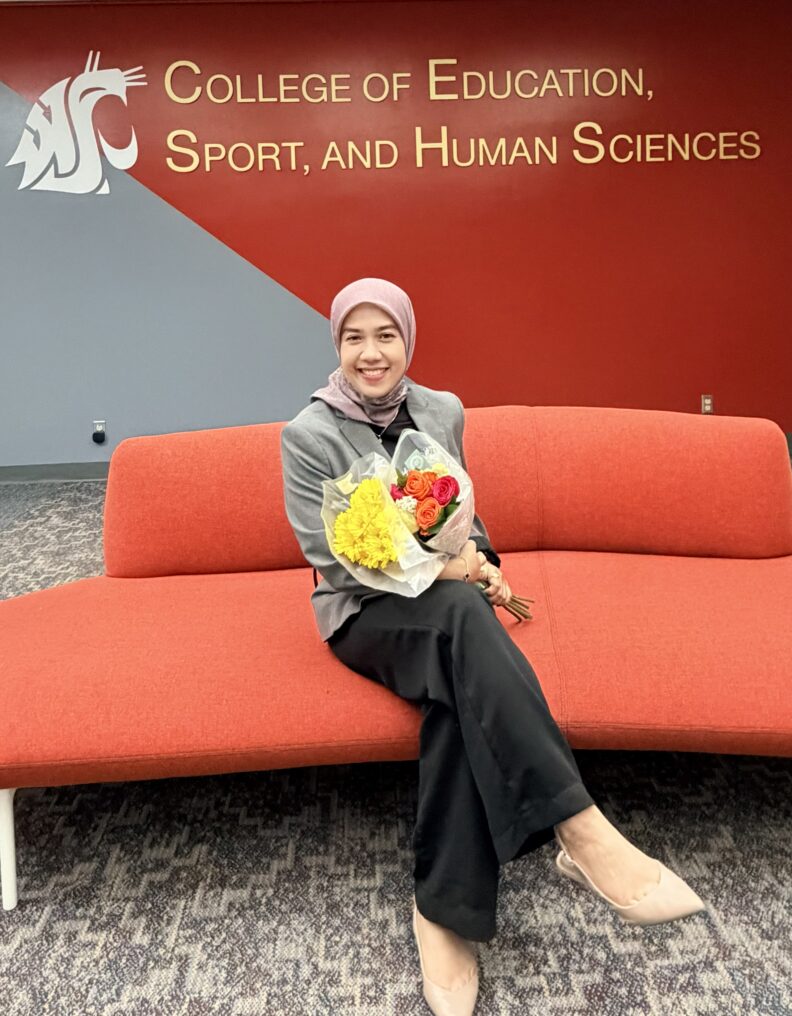
Fulbright Scholar, Dini Arini, will graduate with a Ph.D from the Language, Literacy, and Technology program on May 9.
Originally from a small city south of Borneo on one of the largest islands in Indonesia, Arini comes from a background in English teaching and has spent her time at Washington State University focusing on utilizing Artificial Intelligence (AI) as a tool for new language learners.
Arini was asked some questions about her time at WSU. Some questions and answers have been condensed for clarity.
What is your area of study, and what drew you to this research?
My area of study is Language, Literacy, and Technology, with a particular focus on English as a Second Language (ESL) and English as a Foreign Language (EFL) teaching and the use of technology, especially artificial intelligence, to support language learning. What drew me to this field was my own experience as a child learning English. I struggled with the language, and many of my friends were able to improve because their parents could afford extra classes outside of school. In my case, that was not possible. I did not have access to that kind of support, so I often had to rely on whatever resources I could find on my own. Looking back, I often think about how different my learning journey might have been if the technologies available today had existed then, tools that allow learners to practice independently, receive immediate feedback, and continue learning beyond the classroom.
That personal experience became the foundation of my research interest. I have always been drawn to questions of access, opportunity, and support for learners who may not have the same advantages as others. I want to help create learning environments where students, especially those from under-resourced backgrounds, can still thrive and build confidence in language learning.
Now, with the rise of generative AI, the possibilities are even greater. For non-English speakers, these tools can be a real blessing. They can help learners explain ideas, understand difficult materials, practice writing, and engage with language in ways that were once much harder to access without a tutor or expensive courses. In many ways, generative AI has the potential to make language learning more inclusive and more reachable for students around the world.
At the same time, using these tools well and ethically is a different challenge. Questions about fairness, dependency, authorship, critical thinking, and responsible use cannot be ignored. That is why my research interest also focuses on how AI can be implemented ethically in language classrooms. I am interested not only in what these technologies can do, but also in how educators can use them in ways that support learning, protect student agency, and encourage responsible engagement. For me, this work is both academic and deeply personal, because it connects my own journey as a language learner with my hope to create better opportunities for others.
What has the Fulbright program meant to you?
The Fulbright program has completely transformed my life. It gave me access to opportunities that would have been very difficult to reach otherwise, including pursuing a PhD in the U.S., engaging in high-level research, and presenting my work at international conferences. Beyond academics, it expanded my worldview. I have been able to connect with people from many different backgrounds, exchange ideas, and represent my home country in meaningful ways. It also comes with a strong sense of responsibility. I do not just see it as a scholarship, but as a commitment to use what I have learned to contribute back, especially in improving education and shaping how AI can be used ethically and effectively in learning environments.
What did you like about the Pullman campus, and what is your fondest memory at WSU?
What I appreciate most about WSU is the strong sense of community. Faculty are approachable, and there is a genuine willingness to support students both academically and personally. It is common to have meaningful conversations with professors outside of class, and that has made a big difference in my growth. The campus itself is also very focused, which helps with productivity; there are fewer distractions compared to larger cities.
At the same time, Pullman, being a small town, has its challenges. Access to certain resources, professional networks, or cultural activities can be limited, and travel often requires more planning. For example, attending conferences or even accessing specialized services usually involves long trips. While this can be inconvenient, it also taught me to be more intentional with planning and to make the most out of the opportunities available on campus.
One of my fondest memories is presenting my research at conferences and realizing that the work I started in Pullman could resonate with a broader academic audience. Traveling to different cities, sharing ideas, and receiving feedback from scholars has been very meaningful. At the same time, every time I returned to Pullman, it felt like coming home. That contrast made me appreciate WSU even more. The quiet environment, the familiar campus, and the people I worked with became a constant support system throughout those experiences. It is that combination, growing professionally outside while always having a strong base at WSU, that stands out the most to me.
Who was important to you, or guided you in your time at WSU?
My family has been a central source of support throughout my journey. Managing a PhD while also being a parent required balance, and their support made it possible. Academically, my advisors and faculty mentors played a critical role. They did more than provide feedback on my research, they guided how I think as a researcher, how I frame problems, and how I approach my work with clarity and purpose. They trusted me with responsibilities, encouraged me to present and publish, and supported me during key moments such as preparing for conferences and my dissertation. That combination of personal and academic support shaped my entire experience.
What do you plan to do post-graduation?
After graduation, I plan to continue working in higher education, combining teaching, research, and policy work. My main focus is on AI in education, particularly how institutions can move from general or reactive policies to more practical, actionable, and ethical frameworks. I want to contribute to developing guidelines that actually help instructors and students use AI responsibly, rather than just restricting it. I am also interested in supporting multilingual learners through AI tools and designing systems that are inclusive and accessible. In the long term, I hope to contribute both academically and practically, potentially working across universities and educational systems, including in developing contexts.